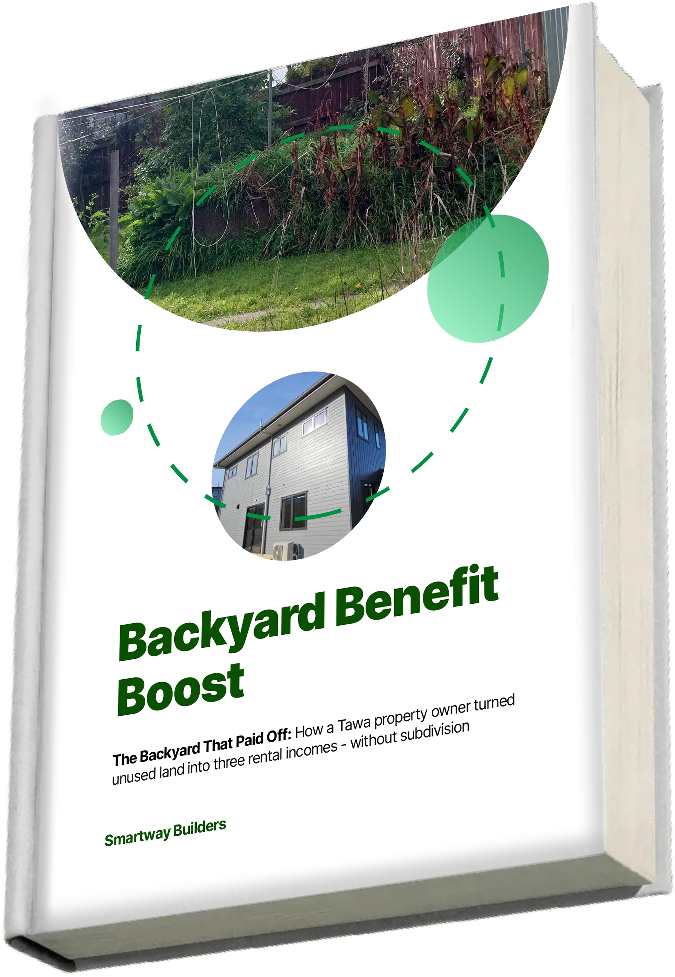


How a Wellington property owner turned idle rear land into three rental incomes — without subdivision, without budget blowouts, and without becoming a developer.
Many Wellington property owners are sitting on a “lazy asset” without realising it. Land they already own. Land that produces no income. Land they assumed would be too hard, too costly, or too complicated to ever put to work.
This is the story of what happens when that assumption is tested — and found to be wrong.
The Starting Point: Valuable Land Doing Nothing
The owners were long-term Wellington property holders. Not developers. Not speculators. People focused on practical, long-term rental performance, who happened to own a property with a large rear section producing no return.
For years, the land sat idle. Valuable on paper. Invisible in the income statement.
Like many investors, they had assumed that unlocking the land would require subdivision with all the cost, complexity, timeframes, and stress that brings. So, they did nothing.
The turning point came when the right question was finally asked. Not: “How do we develop this?” But: “What income potential is being left on the table?”
The Approach: Yield First, Not Development First
Using Smartway's Build Smart process, feasibility, architectural concept design, buildability and early cost testing were worked through together. It became clear that two additional dwellings could be added to the existing property, all on the same title, without subdivision, and in a way that made financial sense.
This reframed everything. The project was not a development. It was yield maximisation. Converting a dormant asset into a reliable, long-term income stream.
Two new two-storey, three-bedroom homes were designed and built specifically for long-term tenants. Practical. Low maintenance. With off-street parking. Delivered on a fixed-price, turnkey basis.
The objective was not architectural flair or winning awards. It was predictable income, low maintenance, and minimal stress, built to perform as a rental investment for years to come.
The Result: One Property. Three Incomes.
The transformation is best understood by looking at what changed — and what didn't.
| Metric | Before | After |
|---|---|---|
| Properties on Title | 1 | 3 |
| Rental Streams | 1 | 3 |
| Annual Rental Income | 1x | 3x |
Two additional income streams. No new title. No subdivision. The result was a tripling of rental income created from land that was previously producing nothing.
That is not a marginal improvement. It is a fundamental shift in what this property earns.
Three times the income. Zero subdivision. One title. Land that was already owned.
Having trouble viewing? Download the PDF instead.
Investment Reality Check & Capital Value Context
This project involved a significant build investment. The yield delivered on that capital was higher than the owners anticipated — a solid, defensible, risk-aware outcome for new, low-maintenance residential assets in Wellington. Not a quick flip. A long-term income and resilience strategy, backed up by potential capital growth.
Independent market data confirms what the numbers suggest — adding two income-producing dwellings to an existing title delivers a material uplift in the overall capital value of the property.
That was never the goal of this project. The goal was reliable income, long-term resilience, and a return that justified the investment. The capital uplift is a consequence of doing that well — not the strategy itself.
It strengthens the position, although it was not the point.
Smartway Builders' Value: In the Owner's Own Words
Beyond the numbers, this project worked because of how it was delivered. Smartway Builders did not simply construct two additional dwellings. They removed friction, uncertainty, and cognitive load for owners who explicitly did not want to become developers.
The following sections detail exactly how Smartway delivered that value — in the owner's own words.
A. Design & Budget Aligned to the Site and the Numbers
Rather than arriving with a standard design and pushing it through, Smartway used Build Smart to develop and test the architectural design against the site, planning rules, buildability and budget. Design and cost were refined together until the project made sense financially and practically.
“They went back and adjusted the plans again to get the cost to where the bank was happy with it. They seemed to know what the bank sort of wants — and whatever they sent, the bank was happy with.”
B. One-Stop, End-to-End Delivery
The owners had no desire to manage architectural design, planners, builders and council separately. They didn't need to. Smartway coordinated the architectural design and the wider project process from early concept and feasibility through to consents, earthworks and completion - delivering clarity, certainty and confidence throughout.
“It was kind of like a one-stop shop for us… from the concepts to the earthworks, everything was done by them. We haven't built before. We didn't want to become developers. We don't have any passion for it.”
C. Fixed-Price Certainty
Cost uncertainty is what stops most property owners from proceeding with projects like this. A fixed-price contract removed that risk entirely. The costs were what they expected. There were no requests to go back to the bank for more.
“It is a fixed price contract… the costs were what we expected. We didn't have to get the bank to lend more.”
D. Bank-Ready Documentation and Financing Support
Getting finance approved for a multi-dwelling project is a common sticking point. Smartway structured the proposals in a way lenders understand — and iterated designs and costs until the lending requirements were met.
“Howard and Ann helped us get the proposal together for the bank… it was easy for us to get the approval.”
E. Advice Grounded in Rental Performance
Every design decision was driven by what would perform as a rental — not personal taste, not architectural flair, not chasing awards. Practical bedrooms, sensible finishes, off-street parking. Nothing more than the market needs. Nothing less.
“We told them we wanted practical rental properties… not really cheap, not really expensive — just middle-of-the-range. They would tell us straight off whether something could be done or not.”
F. The Net Effect
Smartway's value was not just technical delivery. It was making a complex project feel manageable — turning uncertainty into clarity, and allowing the owners to improve their investment position without changing who they are.
“It's good for people like us who want a hands-off approach, but also want good results."
The Bigger Lesson & Backyard Benefit Boost Callout
The Bigger Lesson: Lazy Assets Are Everywhere
Across Wellington, there are properties sitting on oversized sections. Land doing nothing. Owned by people who have told themselves that development is “too hard.”
This case study demonstrates three things clearly:
• Subdivision is not always required to unlock the value of surplus land
• Yield can be improved — and capital growth can be an added bonus
• Measuring feasibility changes everything — because lazy assets only stay lazy until someone measures them properly
The question is not whether the land has potential. The question is whether you have asked the right question about it.
The Smartway Backyard Benefit Boost
This project didn't turn a property into a get-rich-quick scheme. It turned surplus land into a durable, income-producing asset — with clarity, certainty, and control.
That is the essence of the Smartway Backyard Benefit Boost — designed to unleash the potential of the backyard with minimal risk and without the perceived hurdles that stop most property owners from ever asking the right question.
If you own a property with under-utilised land, the first step is not jumping straight to a build quote or developing detailed plans in isolation. It is a structured feasibility, architectural concept design and yield assessment - grounded in real numbers, site constraints, buildability and practical design possibilities.
Frequently Asked Questions
Yes. Under Wellington's residential planning rules, it is possible to add one or more dwellings on an existing title without formal subdivision — provided the site meets relevant planning requirements. This approach avoids the cost and complexity of creating new titles while still generating additional rental income from the same land. A proper feasibility assessment is the essential first step.
Yield maximisation is the strategy of increasing rental income from an existing property by making better use of available land or space — rather than waiting for capital growth. In residential property, this often means adding dwellings to an existing site using a disciplined, income-first approach that considers planning rules, build costs, lending requirements, and rental market conditions together.
Timeframes vary depending on site conditions, design complexity, consent processes, and build programme. The most important factor is starting with a thorough feasibility assessment — this determines what is achievable and sets realistic expectations before any commitment is made.
Smartway Builders offers an end-to-end service beginning with Build Smart - its structured feasibility and architectural design process - and continuing through consents, bank documentation and fixed-price construction. The approach is designed for long-term property investors who want reliable rental income without managing the complexity of a build project themselves. They operate across Wellington, the Hutt Valley, and the Kapiti Coast.
A lazy asset is land or property that is owned but not generating income commensurate with its potential. In residential property, this commonly describes a rear section, underutilised yard, or large lot that could accommodate additional dwellings — but has been left idle because the owner assumed development was too complex, too costly, or required subdivision.
More questions? Visit our full FAQ