


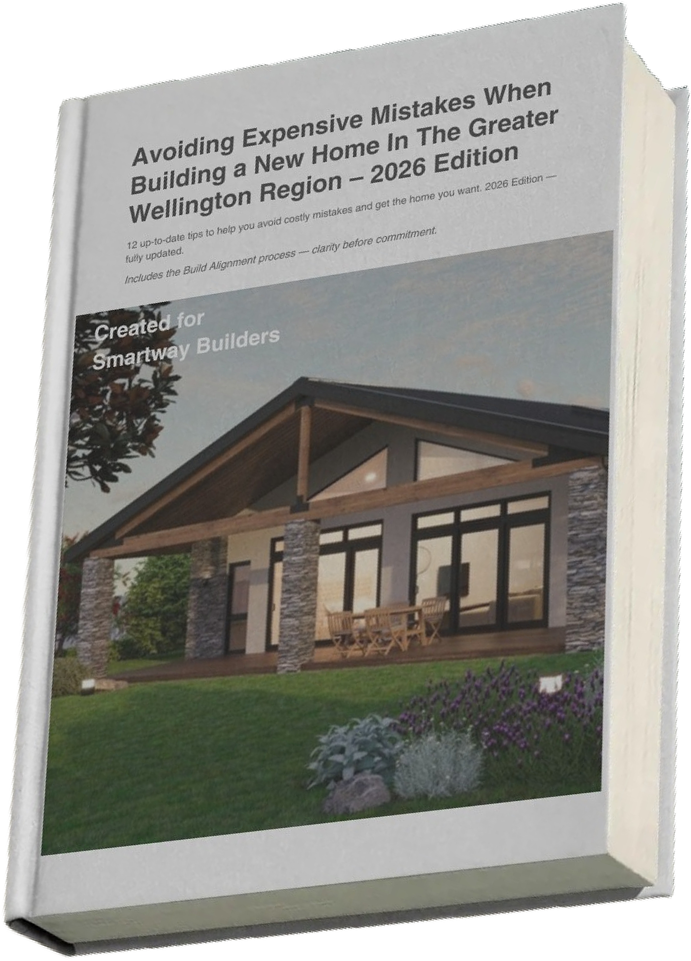
Avoiding Expensive Mistakes When Building a New Home in the Greater Wellington Region — 2026 Edition
12 up-to-date tips — fully revised for 2026's biggest building law changes in a generation — to help you avoid costly mistakes and get the home you actually want.
Building a new home in Wellington City, the Hutt Valley, or the Kapiti Coast in 2026 means navigating steep sections, strict building codes, and high construction costs — and this year, more regulatory change than any generation before you.
Since the 2025 edition of this guide, New Zealand's building and construction sector has seen mandatory home warranties confirmed, a shift to proportionate liability for defects, tougher penalties for Licensed Building Practitioners, new H1 energy-efficiency standards, a private consenting authority, and a Planning Bill set to replace the RMA.
Every one of the 12 tips in this free guide has been reviewed against 2026 regulations, so you're planning against today's rules — not last year's.
Learn about navigating steep sections, strict building codes, and high construction cost.
Regulatory changes since the 2025 edition, woven through every tip:
Mandatory Home Warranties
All new residential buildings up to three storeys (1-year defect period, 10-year structural warranty) — Building Amendment Bill expected in Parliament in 2026
Proportionate Liability
Replacing joint and several liability for defective work, alongside mandatory professional indemnity insurance for architects and engineers.
Stronger LBP Penalties
Maximum fines rising from $10,000 to $20,000, suspensions from 12 to 24 months.
2025 Building Code Updates
New H1 energy-efficiency and updated B1 structural standards, transitioning through November 2026.
Private Consenting Authority
Now operating for low-risk residential projects, with up to a third of inspections done remotely.
RMA Reform
The Planning Bill and Natural Environment Bill expected to be enacted in 2026, reshaping resource consent requirements.
See every source behind these updates on our full references page.
12 Tips Overview
Your Title Goes Here
Your content goes here. Edit or remove this text inline or in the module Content settings. You can also style every aspect of this content in the module Design settings and even apply custom CSS to this text in the module Advanced settings.
Choose the Right Location/Section
Steep land, access, and hazard checks that can swing costs by $50,000–$150,000+.
Design a Layout That Works for You
Maximise Your View and Sun
While budgeting for Wellington's wind and high-performance glazing.
Understand What Drives Building Costs
Site, size, materials, and scope.
Spend Time Getting It Right in the Planning Stage
Develop the design, scope and cost picture before construction begins.
Don't Cut Corners – Quality Counts
Restricted Building Work, LBPs, and durability.
Choose the Right Building Company
Credentials, track record, and the private consenting question.
Have a Signed Contract (and Understand It)
Including the new mandatory warranty obligations.
Get a Fixed Price for the Job
Budget certainty and bank financing.
Specify Good Quality Products and Materials
Certification and the new Building Product Specifications.
Don't Try to Do-It-Yourself
What the law restricts and why.
Plan for Patience
Relax and Enjoy the Process
Build Smart: Clarity Before Commitment
Build Smart is Smartway Builders' structured early planning and architectural design process. It brings together your site, goals, scope and budget with architectural concept design, feasibility, buildability review and preliminary QS pricing, so what is likely to be achievable can be tested before significant money is invested in detailed design, consultants and consenting.
The result: informed decisions early - when changes are easier and less costly - rather than expensive surprises during construction.

About Smartway Builders
Written by Smartway Builders, a locally owned building company serving Wellington City, the Hutt Valley, and the Kapiti Coast. Every regulatory reference is sourced from MBIE, Building Performance, and Beehive.govt.nz (full list in the guide).
Your Title Goes Here
Your content goes here. Edit or remove this text inline or in the module Content settings. You can also style every aspect of this content in the module Design settings and even apply custom CSS to this text in the module Advanced settings.
Building vs. Buying a Home: Which Path is Right for Your Kiwi Dream?
Navigate building vs. buying a home in Wellington. Find your path to the Kiwi dream...
Enhancing Your Home's Potential: Landscaping & Retaining Walls
Enhance your Wellington property with expert fence solutions for privacy, security, and style...
Popular Home Designs for Beachside Properties
Craft your coastal dream home. Discover popular beachside designs for Wellington that blend aesthetics and resilience....
Our Services
Whether you’re building or renovating a dream home, we simply make it happen.
House and Land Packages
Embrace the kapiti coast lifestyle: house and land packages with smartway builders
Frequently Asked Questions
Your Title Goes Here
Your content goes here. Edit or remove this text inline or in the module Content settings. You can also style every aspect of this content in the module Design settings and even apply custom CSS to this text in the module Advanced settings.
What are the biggest mistakes people make when building a new home in Wellington?
The most common costly mistakes are underestimating site costs on steep sections, starting construction without complete drawings and specifications, accepting a verbal or vague quote instead of a fixed-price contract, and cutting corners on Restricted Building Work like framing and waterproofing.
What building law changes are happening in New Zealand in 2026?
2026 brings mandatory home warranties for new residential buildings, a shift to proportionate liability for defective work, higher LBP disciplinary penalties, new H1 energy-efficiency building code standards, a private building consent authority, and a Planning Bill expected to replace the RMA.
Do I need a fixed-price contract to build a house in NZ?
It isn't legally required, but a fixed-price contract gives budget certainty, shifts material and labour cost risk to the builder, and is typically required by NZ banks before releasing construction loan funds.
Are home warranties mandatory for new builds in New Zealand?
Not yet, but they will be. The Building Amendment Bill, expected before Parliament in 2026, will require mandatory home warranties — a 1-year defect period and 10-year structural warranty — for all new residential buildings up to three storeys
How much more does it cost to build on a steep section in Wellington?
A moderate 10–15 degree slope can add meaningful foundation and retaining costs; a 40–45 degree slope can add $50,000–$100,000 or more in engineering and earthworks, plus further costs if site access is narrow or steep.
What is proportionate liability for building defects?
Proportionate liability is a 2026 legal shift where each party responsible for defective building work — builder, engineer, or architect — is only liable for their own share of the fault, replacing the previous joint-and-several model.
What is Build Smart?
Build Smart is Smartway Builders' structured early planning and architectural design process. It combines site and project information with architectural concept design, feasibility, buildability review and preliminary QS pricing so the homeowner can understand what is likely to be achievable before investing heavily in detailed design, consultants and consenting.
Do I need a Licensed Building Practitioner for a new build in Wellington?
Yes. Restricted Building Work — structural framing, roofing, and waterproofing — must legally be carried out or supervised by a Licensed Building Practitioner (LBP). You can verify any builder's LBP status on the public register.
More questions? Visit our full FAQ
Ready to build with clarity, control, and peace of mind?
Get your free copy of the 2026 Edition.
Renovating instead of building new?
We've got a guide for that too.