


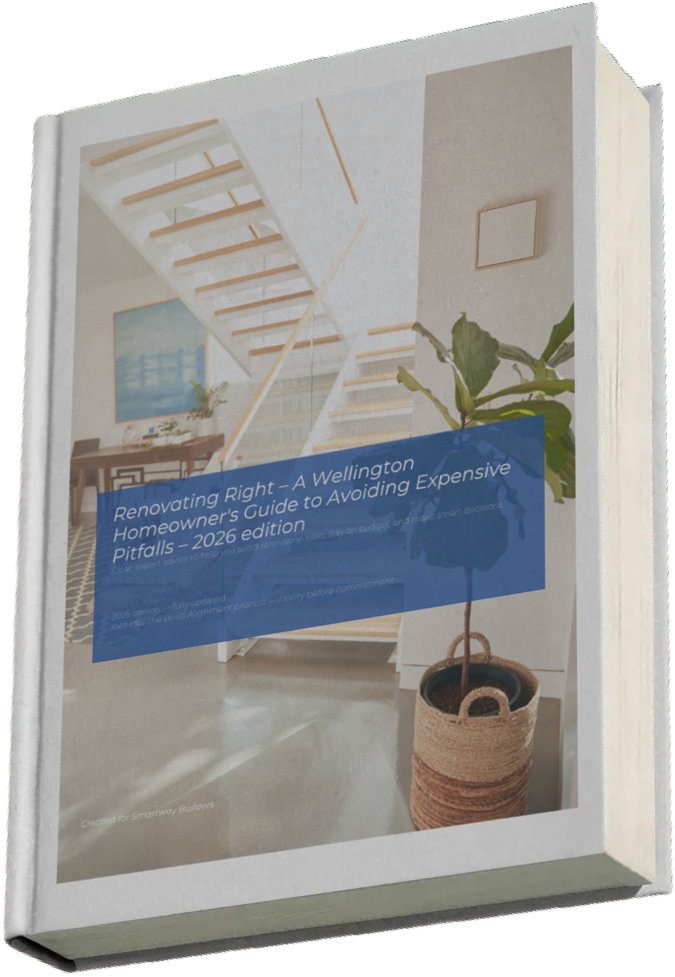
Renovating Right: A Wellington Homeowner's Guide to Avoiding Expensive Pitfalls — 2026 Edition
8 up-to-date tips — fully revised for 2026's biggest building law changes in a generation — to help you renovate with confidence and avoid costly mistakes.
Renovating your home in Wellington City, the Hutt Valley, or the Kāpiti Coast can add tremendous value and comfort
But it comes with real risks, and 2026 brings the biggest wave of building law change in a generation. Landmark reforms are reshaping how consents work, how liability is shared, and what guarantees homeowners can expect, while earthquake-prone terrain, high winds, and a mix of heritage and modern housing add extra complexity.
This updated guide reviews eight common ways a renovation can go wrong - and how Smartway Builders' Build Smart process helps you work through the early planning, architectural design and cost decisions before construction begins - so you're planning against today's rules, not last year's.
What's New in 2026
Since the 2025 edition, New Zealand's building and construction sector has seen its most significant legislative activity in a generation. Here's what every Wellington homeowner needs to know heading into a renovation project in 2026:
New Consent Exemptions
The Building and Construction (Small Stand-alone Dwellings) Amendment Act 2025 exempts granny flats up to 70m² and roof-mounted solar panels up to 40m² from building consent — LBP involvement and full Building Code compliance still required.
Proportionate Liability & Mandatory Warranties
Liability shifting from joint-and-several to proportionate, paired with mandatory home warranties on consented renovations of $100,000+ (1-year defect period, 10-year structural warranty) and mandatory professional indemnity insurance for architects and engineers
Earthquake-Prone Building Reforms
A move to a risk-based EPB system, removing NBS percentage thresholds — around 2,900 Wellington buildings expected to come off the register, with four-year deadline extensions for buildings with unexpired notices
2025 Building Code Updates (H1, B1)
New H1 energy-efficiency and updated B1 structural standards took effect in late 2025, with a 12-month transition period. Consents lodged after November 2026 must use the new H1 documents.
RMA Reform / New Planning System
The Planning Bill and Natural Environment Bill are expected to be enacted in 2026, reducing activity categories and eliminating consents for many low-impact activities. Existing RMA rules apply for now.
See every source behind these updates on our full references page.
8 Tips Overview
Your Title Goes Here
Your content goes here. Edit or remove this text inline or in the module Content settings. You can also style every aspect of this content in the module Design settings and even apply custom CSS to this text in the module Advanced settings.
Only Do What You Can Afford
Set a realistic budget with 10–20% contingency, secure financing upfront, and separate needs from wants.
Have a Signed Contract
Mandatory for jobs $30,000+, should cover inclusions/exclusions, timeline, payment schedule, and dispute resolution.
Only Make Payments at Agreed Stages
Make payments only against clearly agreed work, services, costs or project stages, and make sure you understand what each payment covers.
Insist On a Written Guarantee
At least a 10-year written guarantee, on top of the 12-month defect repair period and incoming mandatory home warranties.
Choose The Right Building Company
Verify LBP licensing, track record, and local council knowledge; watch for phoenix companies.
Don't Cut Corners
Proper materials, no bypassing consents, no skimping on structure or weatherproofing.
Don't Make Changes Unless Absolutely Essential
Variations cost money and time; finalise decisions in the planning phase instead.
Don't Try To Do It Yourself
Restricted Building Work needs an LBP; DIY work risks insurance, resale value, and safety.
Build Smart: Clarity Before Major Commitment
Renovation regrets often start with a plan that has moved too far before the scope, design and likely cost have been properly tested. Build Smart is Smartway Builders' structured early planning and architectural design process. It brings your ideas, existing home, goals and budget together with architectural concept design, feasibility, buildability review and preliminary QS pricing so key decisions can be tested before significant money is invested in detailed design, consultants and consenting.
The result is greater clarity early - when changes are easier and less costly - rather than discovering misalignment during construction.

About Smartway Builders
Written by Smartway Builders, a locally owned building company serving Wellington City, the Hutt Valley, and the Kapiti Coast. Every regulatory reference is sourced from MBIE, Building Performance, and Beehive.govt.nz (full list in the guide).
Your Title Goes Here
Your content goes here. Edit or remove this text inline or in the module Content settings. You can also style every aspect of this content in the module Design settings and even apply custom CSS to this text in the module Advanced settings.
Optimising Your Home's Exterior: Expert Window & Cladding Solutions
Optimising Your Home’s Exterior: Expert Window & Cladding Solutions...
Elevate your Greater Wellington home! Get expert guidance for a quality master suite extension to boost value
Elevate your Wellington home! Get expert guidance for a quality master suite extension to boost value...
Home Alterations for Safety and Accessibility
Expert home alterations in Wellington ensure safety, accessibility, and peace of mind for your evolving needs...
Enhancing Your Outdoor Living: Decks, Pergolas, Paths & Driveways
Unlock your home's outdoor potential with expert landscaping and safe retaining walls. Transforming your outdoor space can profoundly impact your...
Frequently Asked Questions
Your Title Goes Here
Your content goes here. Edit or remove this text inline or in the module Content settings. You can also style every aspect of this content in the module Design settings and even apply custom CSS to this text in the module Advanced settings.
What are the most common mistakes homeowners make during a Wellington renovation?
The most common mistakes are underestimating budget and contingency, starting without a written contract, paying large deposits upfront, skipping consents or cutting corners on quality, and attempting DIY work that legally requires a Licensed Building Practitioner.
What building law changes are happening in New Zealand in 2026 that affect renovations?
2026 brings consent exemptions for granny flats and solar panels, a shift to proportionate liability, mandatory home warranties for consented renovations of $100,000 or more, new H1 and B1 building code standards, and a Planning Bill expected to reform the resource consent system.
Do I need a written contract for a home renovation in NZ?
Yes for any job costing $30,000 or more (including GST) — it's a legal requirement — and it's strongly recommended even for smaller jobs to avoid disputes over inclusions, exclusions, and payment terms.
How much contingency should I budget for a renovation?
At least 10% of your budget, and 15–20% for larger projects or older Wellington homes, where hidden issues like rot, outdated wiring, or unexpected seismic strengthening needs are common once walls are opened up.
Are home warranties mandatory for renovations in New Zealand?
Not yet, but they're coming. The government has confirmed mandatory home warranties — a minimum one-year defect period and 10-year structural warranty — for all consented residential renovations of $100,000 or above, with legislation progressing through Parliament in 2026.
What is Build Smart?
Build Smart is Smartway Builders' structured early planning and architectural design process. It combines your renovation goals and budget with architectural concept design, feasibility, buildability review and preliminary QS pricing so the likely scope and cost can be tested before significant investment in detailed design, consultants and consenting.
Can I do renovation work myself (DIY) in Wellington?
Restricted Building Work — structural work, weatherproofing, and sanitary plumbing — must be done or supervised by a Licensed Building Practitioner. An owner-builder exemption exists but has strict conditions and must be disclosed when you sell.
What should I look for when making deposits or staged payments on a renovation?
Deposits or staged payments may legitimately be required before physical construction begins for design, consultant coordination, preconstruction work, procurement or programme commitments. What matters is that each payment is clearly documented, understood and linked to an agreed stage, service, cost or commitment.
More questions? Visit our full FAQ
Ready to build with clarity, control, and peace of mind?
Get your free copy of the 2026 Edition.
Renovating Right Download 2026
Building a new home instead of renovating?
We've got a guide for that too.